“If you want to make everyone happy, don't be a leader, sell ice cream!"(Steve Jobs)Wenn Du es nicht aushältst, unbeliebt zu sein: Werde kein Beirat!(Ulvi I. AYDIN)“If you want to make everyone happy, don't be a leader, sell ice cream!"(Steve Jobs)Wenn Du es nicht aushältst, unbeliebt zu sein: Werde kein Beirat!(Ulvi I. AYDIN)“If you want to make everyone happy, don't be a leader, sell ice cream!"(Steve Jobs)Wenn Du es nicht aushältst, unbeliebt zu sein: Werde kein Beirat!(Ulvi I. AYDIN)“If you want to make everyone happy, don't be a leader, sell ice cream!"(Steve Jobs)Wenn Du es nicht aushältst, unbeliebt zu sein: Werde kein Beirat!(Ulvi I. AYDIN)“If you want to make everyone happy, don't be a leader, sell ice cream!"(Steve Jobs)Wenn Du es nicht aushältst, unbeliebt zu sein: Werde kein Beirat!(Ulvi I. AYDIN)
*
Minuten
“If you want to make everyone happy, don't be a leader, sell ice cream!"
(Steve Jobs)
Wenn Du es nicht aushältst, unbeliebt zu sein: Werde kein Beirat!
(Ulvi I. AYDIN)
Steve Jobs
No items found.
!AYCON Blog
September
20
,
2026
2026
Ich würde die beiden neuen Gedanken nicht nur ergänzen, sondern als Eskalationspunkt in den Text einbauen. Vor allem “Maybe business is still too comfortable” gibt dem Beitrag deutlich mehr Kante.
Where Have All the Hunters Gone?
There are too many average salespeople.
Too many lazy ones.
Too many who wait.
Too many who hide in their comfort zone.
And far too few real hunters.
I wish there were more salespeople with a real hunting spirit.
People who smell an opportunity and go after it.
People who call.
Who follow up.
Who stay close.
Who don't give up after the first, second or third attempt.
People who understand one simple truth:
Customers don't fall into your lap. You have to win them.
I Am a Real Opportunity
Here is a very simple example from my own life.
Every three years, I lease a new car. My current lease still has about six months to run, so I have started looking at what comes next.
BMW X5? Audi Q7? Mercedes GLE? VW Touareg? Maybe something completely different?
Diesel? Plug-in hybrid? Fully electric?
I haven't decided yet.
Which means:
I am a real opportunity.
I have a need.
I have a budget.
I have a timeline.
I am actively researching.
And I will buy.
Through friends, colleagues and business contacts, I was introduced to seven or eight supposedly good car salespeople from different brands.
And then?
Almost nothing happened.
Only two showed genuine interest.
And only one keeps following up regularly.
One.
Out of seven or eight.
He asks whether I have made a decision.
He asks whether he can provide additional information.
He stays in touch.
He wants the business.
That is sales.
The others?
Silence.
They have my name.
They have my contact details.
They know I am looking.
They know I will buy.
They know exactly when I will buy.
And still:
Nothing.
No call.
No message.
No follow-up.
No persistence.
No hunger.
Maybe Business Is Still Too Comfortable
And that makes me wonder:
Maybe things simply aren't bad enough yet.
How bad does business have to get before a salesperson finally leaves his comfort zone?
How much market share do you have to lose?
How many customers have to disappear?
How many targets do you have to miss?
How empty does the pipeline have to become?
Before somebody finally picks up the damn phone?
We talk about difficult markets.
We talk about competition.
We talk about pricing pressure.
We talk about economic uncertainty.
We talk about customers delaying investments.
Fine.
But before blaming the market, answer one question:
Did you really fight for every opportunity?
Or did you send one email, make one call and then wait?
Because waiting is comfortable.
Hunting isn't.
One Contact Is Not Sales
Here is another truth many salespeople apparently still haven't understood:
Winning a new customer may take ten contacts.
Not one.
Not two.
Not three.
Ten.
Call.
Follow up.
Send something relevant.
Call again.
Ask another question.
Create another reason to talk.
Stay visible.
Stay relevant.
Stay on the opportunity.
And yes, sometimes after ten attempts the answer will still be NO.
Welcome to sales.
If you give up after two attempts because the prospect didn't immediately respond, you are not persistent.
If you are afraid of being rejected, you are in the wrong profession.
If you believe sending a quotation means your job is done, you haven't understood sales.
And if you still haven't understood that winning uncertain customers requires repeated, disciplined follow-up:
You are not a good salesperson. Period.
Sales Is Not Order Taking
Too many people working in sales aren't actually selling.
They are administrators with business cards.
They react when customers call.
They answer emails.
They prepare quotations.
They update CRM systems.
They wait.
And when nothing happens, they explain why the market is difficult.
Bullshit.
Sales means creating movement.
Sales means creating opportunities.
Sales means staying close.
Sales means asking.
Sales means following up.
Sales means dealing with rejection.
Sales means getting up and trying again.
Sales means hunting.
My 20–25–50 Rule
This isn't scientific research.
It is my observation after decades in business:
20–25% are real salespeople.
Hungry.
Persistent.
Fast.
Relentless.
They smell an opportunity.
And they go after it.
Another 25% are okay.
They do their job.
They respond.
They follow up occasionally.
They survive.
And then there are the remaining 50%.
The sleepers.
They wait.
They need to be pushed.
They confuse being busy with selling.
They hope the customer will come back.
They complain about the market.
They complain about prices.
They complain about competitors.
They complain about leads.
They complain about everything.
Except their own lack of action.
Hope is not a sales strategy.
The Customer Is Watching You
And here is what many salespeople underestimate:
Your level of interest influences my level of interest.
Of course I compare products.
Price.
Technology.
Quality.
Service.
Total cost.
But I am also evaluating you.
Do you want my business?
Are you hungry?
Are you interested?
Are you listening?
Are you persistent?
Are you fighting to win me?
Because the way you treat me before I become your customer tells me something about how you might treat me after I become your customer.
And yes:
That influences my buying decision.
Get Out of Your Comfort Zone
Sales doesn't need more administrators.
Sales doesn't need more excuses.
Sales doesn't need more people sitting behind screens waiting for incoming orders.
Sales needs hunters.
People with energy.
People with persistence.
People with curiosity.
People with courage.
People with hunger.
People who see an opportunity and think:
I WANT THIS CUSTOMER.
Not:
Let's see whether he calls back.
He might not.
Your competitor might call him first.
So move.
Pick up the phone.
Follow up.
Ask again.
Stay close.
Take the rejection.
Come back.
And if necessary:
Do it ten times.
Because nobody owes you an order.
Nobody owes you a response.
Nobody owes you success.
You have to earn it.
Stop waiting for business.
Get out of your comfort zone.
Start hunting.
And go get the damn customer.
*
Minuten
Stop complaining about the market and the competition!
Stop complaining. Winners do not complain! The act! Relentlessly!
Pferde lügen nicht. Und genau deshalb sind sie großartige Führungskräfte.Was für ein Erlebnis. Was für eine Lektion. Was für ein Perspektivwechsel.Wir waren sechs Teilnehmer von Ameritum – erfahrene Unternehmer, Manager und Führungspersönlichkeiten. Menschen, die glauben, über Führung schon einiges zu wissen.Und dann kamen die Pferde.Keine PowerPoint.Keine Managementtheorie.Keine wohlklingenden Leadership-Phrasen.Nur wir. Die Pferde. Und die unmittelbare Wahrheit.Unter der großartigen Leitung von Andrew Plumpte und seiner Frau Elke haben wir erlebt, was Führung bedeutet, wenn Titel, Visitenkarten und Hierarchien plötzlich vollkommen bedeutungslos werden.Denn einem Pferd ist es egal, wer du bist.Es interessiert sich nicht für deinen Lebenslauf.Nicht für deine Position.Nicht für deine Erfahrung.Nicht für dein Ego.Ein Pferd reagiert auf das, was wirklich da ist.Auf deine Präsenz.Auf deine Klarheit.Auf deine Konsequenz.Auf deine innere Ruhe.Auf deine Körpersprache.Und vor allem darauf, ob das, was du ausstrahlst, mit dem übereinstimmt, was du erreichen willst.Das Feedback kommt unmittelbar. Ehrlich. Unbestechlich.Und genau das macht diese Erfahrung so kraftvoll.Wir sechs haben an diesem Tag unglaublich viel gelernt – über Kommunikation, Wirkung und Führung. Aber mindestens genauso viel über uns selbst.Andrew und Elke schaffen dabei etwas Besonderes: Sie übersetzen die Reaktion der Pferde mit enormer Erfahrung, Kenntnis und Sensibilität in Erkenntnisse, die unmittelbar auf Führung und Zusammenarbeit übertragbar sind.Das ist kein Pferde-Event. Das ist Leadership in seiner ursprünglichsten Form.Keine Masken. Keine Rollen. Keine Ausreden.Bei Ameritum wollen wir genau solche Erfahrungen schaffen: raus aus der Komfortzone, raus aus den üblichen Denkmustern und hinein in Situationen, die neue Perspektiven eröffnen.Dieser Workshop hat genau das geschafft.Intensiv. Echt. Unmittelbar.Danke, Andrew. Danke, Elke.Und danke an unsere vierbeinigen Coaches.Manchmal braucht es ein Pferd, um einem Menschen zu zeigen, wie Führung wirklich wirkt.
The Will to Win
Everybody talks about goals.
I care much more about something else: What are you willing to do to achieve them?
Goals are easy. PowerPoint is easy. Analysis is easy. Explanations are easy.
Execution is hard.
Over decades in management, I have seen brilliant people explain perfectly why something went wrong. They analyze. They rationalize. They produce another slide deck.
And then?
Nothing happens.
I have far more respect for the person who says:
“I got it wrong. I underestimated it. I’ll fix it.”
And then gets to work.
Because in the end:
Discipline beats talent.
Consistency beats occasional brilliance.
Execution beats analysis without action.
Commitment beats excuses.
You don’t need to be the smartest person in the room. You don’t need the most impressive degree. You don’t need perfect conditions.
But you need something that cannot be taught easily:
The will to win.
I call it the Hunting Spirit.
That inner drive that makes you get up again. Attack the problem. Find another way. Make the call. Visit the customer. Take responsibility. Do today what others postpone until tomorrow.
Business can sometimes feel like a battlefield. And battlefields are not always won by those with the most resources.
They are often won by those with courage, discipline, speed, resilience, and the determination to keep moving.
Weak leaders explain endlessly.
Strong leaders take responsibility and act.
Kobe Bryant embodied this mentality: get up early, put in the work, repeat it relentlessly. No excuses. No shortcuts.
And listen carefully to the language people use:
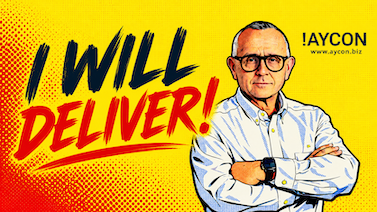
Strong people say: “I will.” “I will do it.” “I will deliver.”
The moment responsibility disappears behind “we will,” “we should,” “we must,” or “we shall,” be careful. Collective responsibility too often becomes no responsibility at all.
Accountability is individual. It cannot be socialized.
Your goals don’t define you.
Your actions do.
And without the will to win, everything else is just decoration.
The AYCON Principles of Interim Management Excellence
Ulvi Aydin, one of the most experienced interim managers in the industry, lives by a simple principle: Love and knowledge are wonderful things—they double when you share them.
Drawing on 21 years of experience, approximately 25 assignments, and 15 industries, he shares these principles as inspiration, guidance, and a legacy for young and new interim managers.
Personality & Mindset
Take ownership from day one.
No one hires an interim manager to sit on the sidelines.
Remain independent in your judgment.
Your loyalty is to the success of the company, not to individual people.
Tell the truth, even when it is uncomfortable.
Diplomacy matters. Clarity matters more.
Earn trust through performance, not through titles.
Always maintain integrity and confidentiality.
Confidentiality is the currency of interim management.
Always act in the best interest of the company.
Not in the interest of individual stakeholders.
Selecting Assignments
Only accept assignments you are qualified to handle.
Experience cannot be improvised.
Critically assess every assignment before signing the contract.
Not every problem can be solved.
Turn down assignments when there is no realistic chance of success.
Integrity before revenue.
Define the objectives with absolute clarity before you start.
Clarify expectations, roles, and responsibilities early.
Never allow yourself to be drawn into political power games.
Starting the Assignment
Listen first. Act second.
Understand the numbers, the processes, and the people equally well.
Build an objective picture of the situation within the first 20 days.
Identify the three biggest levers for impact.
Deliver quick wins without falling into action for action’s sake.
Create transparency based on facts, not opinions.
Leadership & Execution
Lead by example, not by hierarchy.
Make decisions when others hesitate.
Focus on results, not activities.
Being busy is not progress.
Build structures that work without you.
Build ownership instead of dependency.
A good interim manager ultimately makes himself unnecessary.
Change processes, not just people.
Connect strategy with operational execution.
Consistently deliver on deadlines, quality, and budget.
That is simply part of being a professional.
Exit & Legacy
Measure success by sustainable results.
Ensure knowledge transfer before you leave.
Leave behind a stronger company than the one you found.
Your greatest success is when they no longer need you.
Interim management is not a permanent solution. It is about enabling the organization to succeed on its own.
Ulvi: The Essence in One Sentence
“An excellent interim manager creates clarity, trust, results, and sustainable structures in a short period of time—without creating dependency.”
*
Minuten
Clarity! Trust! Results! Executions!
Create Clarity! Create Trust! Deliver Results! Create a good and efficient Structure! Execute!
Wenn Sie auf "Alle Cookies akzeptieren" klicken, stimmen Sie der Speicherung von Cookies auf Ihrem Gerät zu, um die Navigation auf der Website zu verbessern, die Nutzung der Website zu analysieren und unsere Marketingmaßnahmen zu unterstützen. Weitere Informationen finden Sie in unserer Datenschutzrichtlinie.